


Who really won July's couture: Paris's new hierarchies
In brief: July's haute couture week staged three debuts that redraw the map of Paris: Pierpaolo Piccioli at Balenciaga, Matthieu Blazy at Chanel, Jonathan Anderson at Dior. Two weeks on, with the analysis settled and the first quarterly figures on the table, we try to say who really won.
There are couture seasons remembered for a single dress, and seasons remembered because afterwards nothing sits quite where it did. July belongs to the second kind: within the space of a few days, the three most closely watched seats in global fashion presented their opening act, and the play of Parisian hierarchies, frozen for years around the same certainties, started again from scratch.
Piccioli and Balenciaga's return to its origins
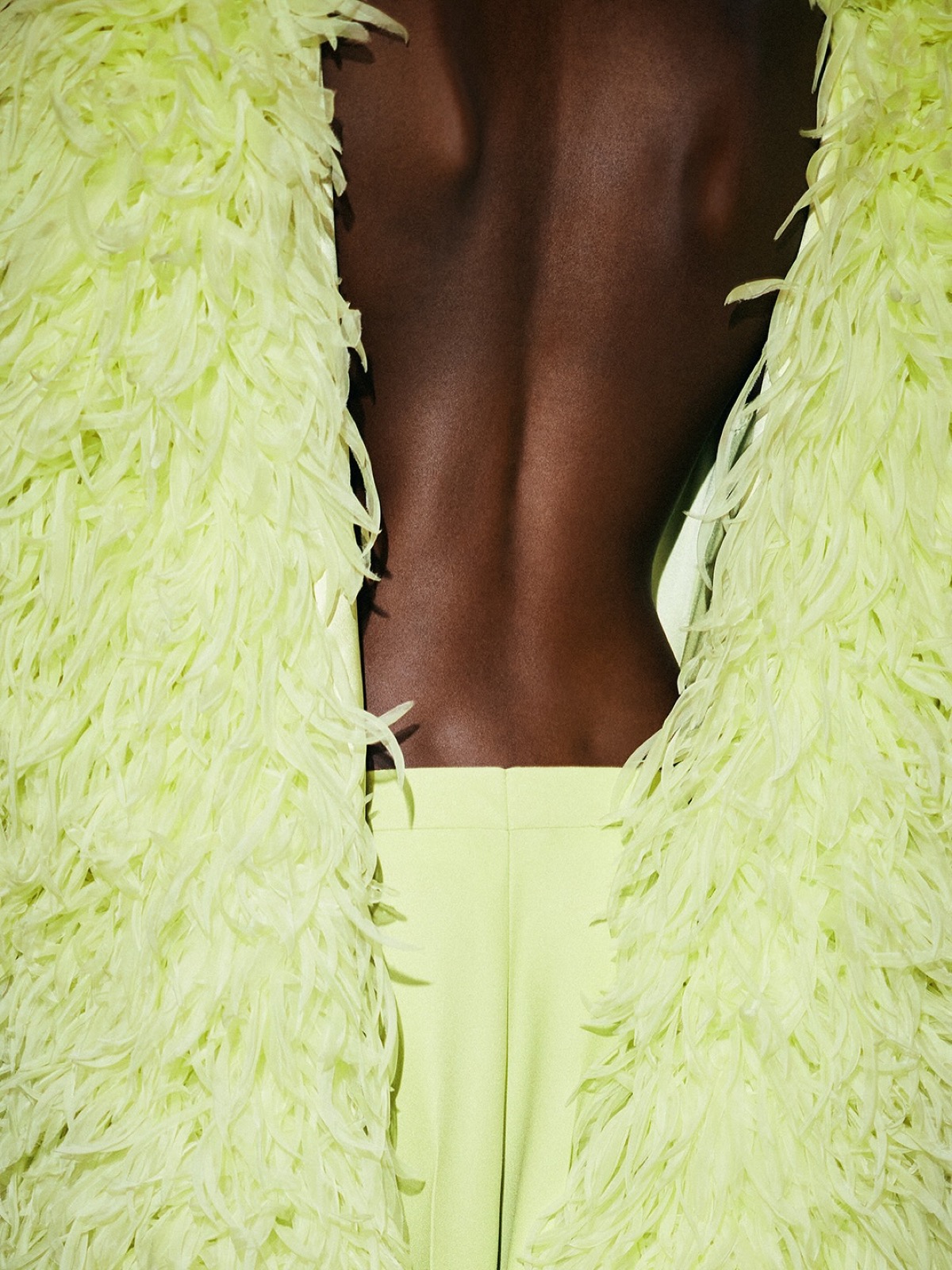
The most eagerly awaited debut was Pierpaolo Piccioli's at Balenciaga, and the designer's choice was as disarming as it could possibly be: no muscle, no provocation, but an almost scholarly return to the origins of Cristóbal the couturier. In the gardens of the Cité Internationale Universitaire, the maison's 55th couture collection spoke the language of pure volumes, of pink, of ostrich feathers, of a construction that invites close inspection. And the line handed to the press reads like a manifesto: to feel completely oneself, inside Balenciaga. After the era of the hoodie and dystopian irony, the label begins again from craft: a cultural wager before a commercial one.
The reactions, arriving in waves over two weeks, confirmed that the wager divides opinion: some read the debut as a scholarly act of love, others would have wanted more rupture. Yet this is precisely the story: for the first time in years, people are discussing Balenciaga in terms of construction, fabrics and silhouette rather than provocation. Piccioli has shifted the terrain of play, and on the terrain of craft few can follow him.
The maison's official account, from its Instagram profile:
Blazy turns the Grand Palais into a fairy tale
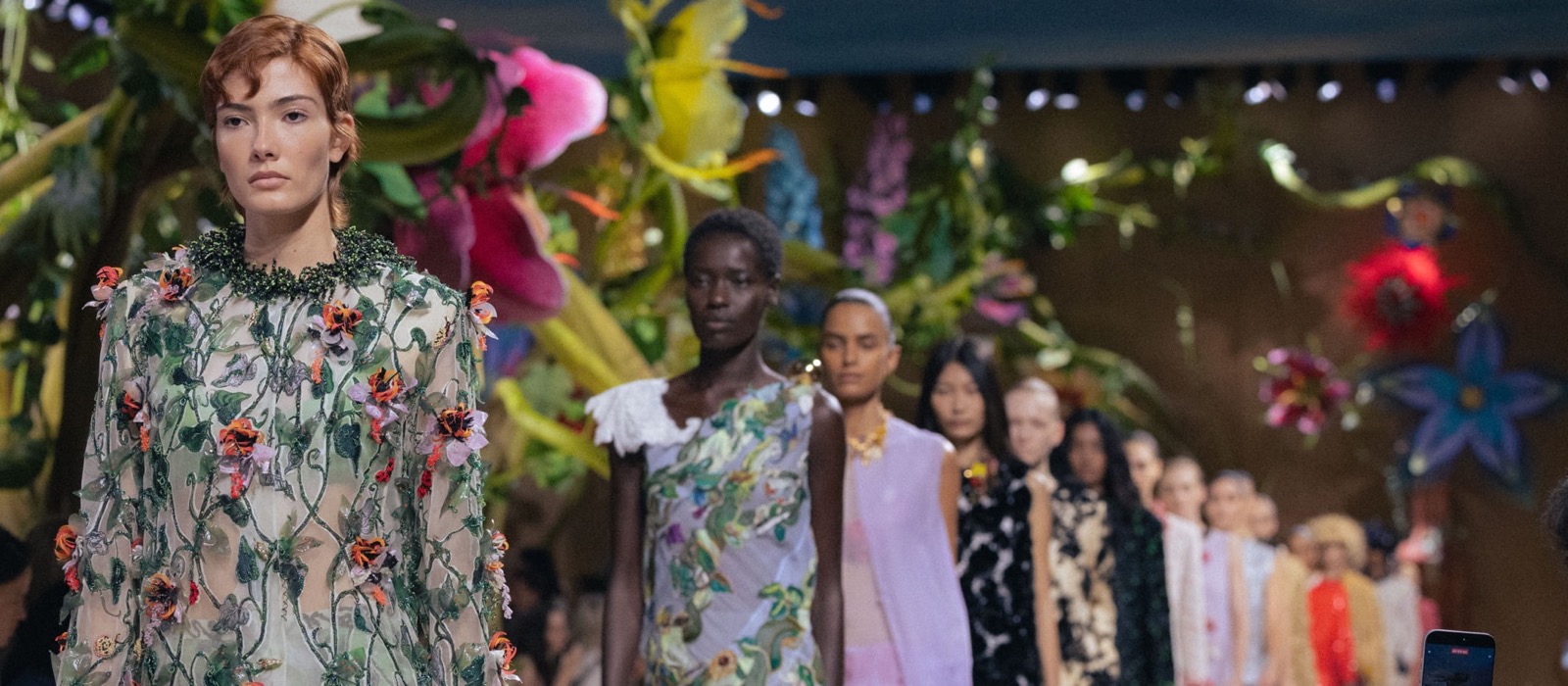
If Piccioli chose subtraction, Matthieu Blazy at Chanel chose wonder: on 7 July the Grand Palais became an enchanted garden of giant flowers for a collection the maison titled like a fable, "Gaby and the Beanstalk". This is the Blazy the world had been waiting for after his miracles at Bottega Veneta: an artisanal hand at outsized scale, a picture-book imagination, and that rare ability to make the heaviest tradition in French fashion feel light. The queues outside the boutiques, meanwhile, show that "Blazy-mania" is no press formula: it is a commercial phenomenon already under way.
Anderson and the Dior of Mughal jewels
There is also a symbolic detail worth recording: the maison returned to show at the Grand Palais, its historic home, and it did so with the first couture chapter of a creative director who arrived with expectations that to call high would be an understatement. The answer was a collection that sought neither a clash with the legacy of Karl Lagerfeld nor the continuity of Virginie Viard, but a third way: the fairy tale as format, craftsmanship as argument. If the aim was to make people talk about Chanel with desire once more, mission accomplished.
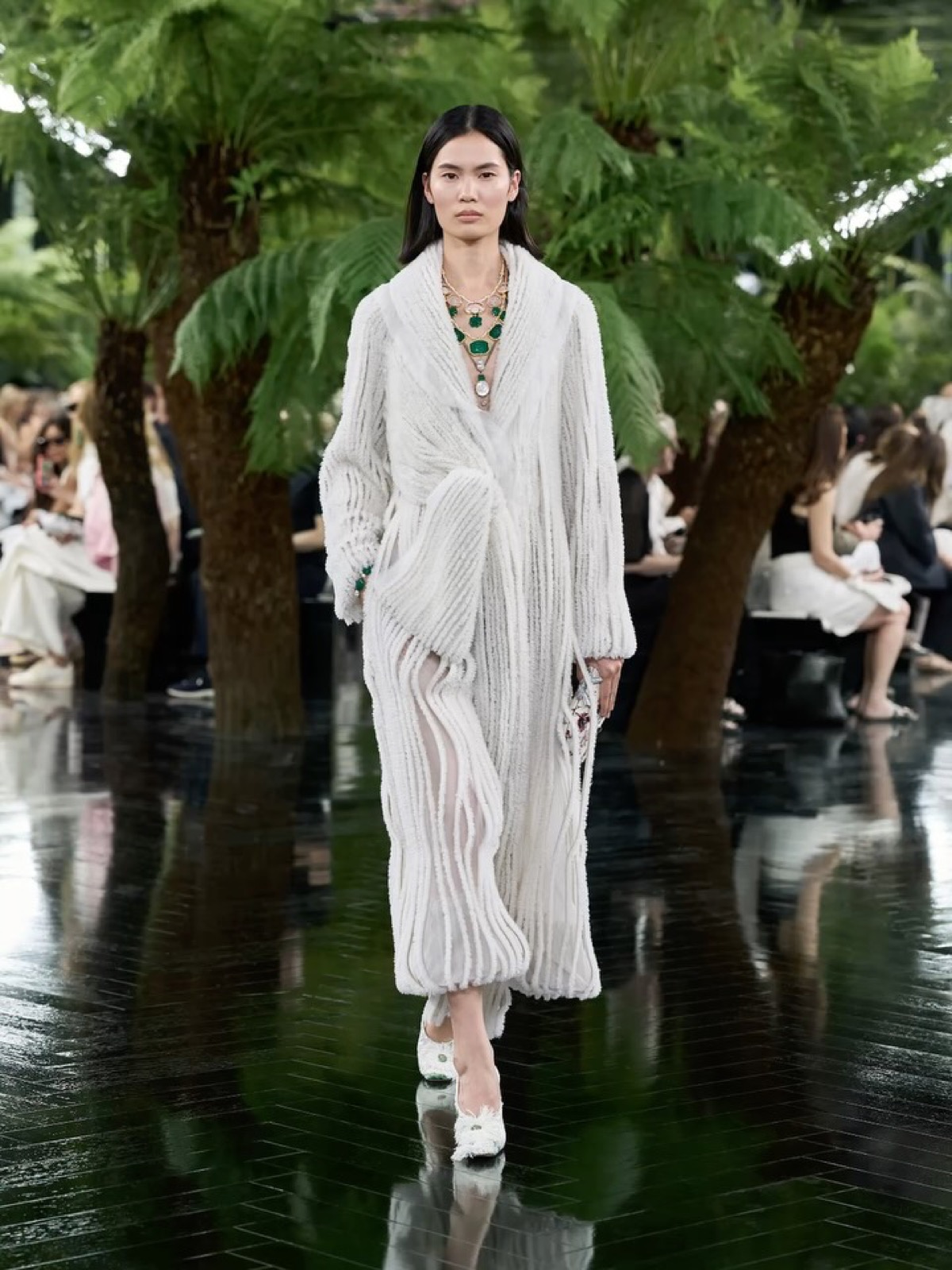
The third act belongs to Jonathan Anderson at Dior: a cultured, layered couture in which a white plissé coat sits alongside an emerald necklace inspired by the historic Mughal Mirror Diamond Necklace, and the runway crosses a forest of tree ferns. Anderson is playing the hardest hand of the three, taking on the most codified legacy in Paris without replicating it, and he plays it as a scholar of the wardrobe: archival quotations, subtle displacements, a luxury that asks for time before it can be read.
And the maison tells it like this:
The provisional verdict (and the test of the numbers)
The structural question remains: what does the market do with three comparable debuts in a single week? A great deal, judging by the signals: couture does not move volumes but it moves desire, and desire is the raw material luxury has hungered for most over the past two years. The three debuts have reignited conversations, queues and anticipation around labels that needed exactly this: a fresh reason to be looked at.
So who won? The honest answer is that three different ideas of couture won: Piccioli's purity, Blazy's wonder, Anderson's complexity. But hierarchies are not measured on the runway alone, and the counter-test has already begun: earnings season opened with Cartier and hard luxury in full stride, and on 27 July LVMH's half-year results will say whether the wave of debuts is turning into real demand. One thing, however, can already be written: for the first time in years, Paris does not have a single centre of gravity. It has three, and not one of the three intends to give way.


Comments
No comments yet. Break the ice!
Log in to comment